
Enterprise Resource Planning (ERP) systems have evolved beyond simple record-keeping tools. Modern organizations require software that can automate processes, centralize information, and adapt to their unique workflows. The Frappe Framework and ERPNext provide exactly that flexibility, allowing businesses to build tailored solutions without sacrificing scalability or maintainability.
Over the course of our development journey, we have implemented several business modules that demonstrate the versatility of the Frappe ecosystem. Each module was designed to solve practical operational challenges while improving user experience and administrative efficiency.
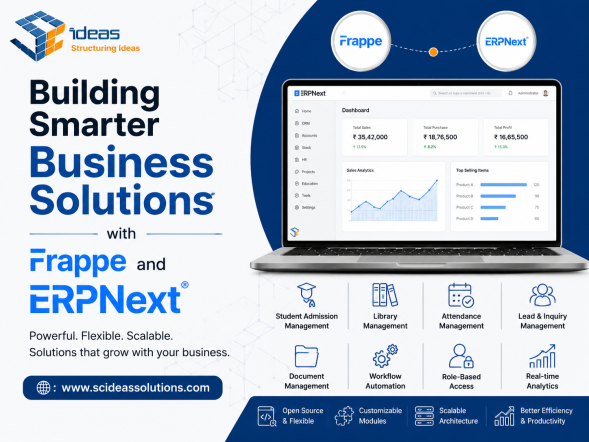
Student Admission Management
The admission process was transformed into a fully digital workflow that simplifies both applicant registration and administrative review. Prospective students can complete a multi-step application form, upload required documents, verify their email through OTP authentication, and securely track their application progress.
The system also allows applicants to save their progress and continue later, reducing incomplete submissions. For administrators, centralized application management and automated validations help maintain accurate records while minimizing manual effort.
Dynamic Academic Configuration
Educational institutions frequently update academic sessions, departments, courses, and class structures. To eliminate repeated code changes, these values are managed dynamically through ERPNext.
By maintaining master data centrally, every update is instantly reflected across the admission portal. This approach improves consistency, reduces maintenance time, and provides administrators with complete control over academic information.
Library Management System
Managing library resources efficiently requires more than maintaining a catalog. Our Library Management module digitizes the complete lifecycle of every book.
Each book is stored with comprehensive details including ISBN information, publisher, author, category, and multiple physical copies. Individual copies are automatically assigned unique tag IDs, allowing librarians to track every book independently throughout its lifecycle.
Smart Rack and Shelf Allocation
Organizing physical books can become difficult as library collections grow. To solve this challenge, we developed an intelligent rack allocation system.
Books can be assigned to blocks, racks, and shelves while the system continuously monitors storage capacity and available space. This provides librarians with real-time visibility into inventory locations and helps prevent storage inconsistencies.
Student Attendance Management
Attendance recording was designed to be both accurate and user-friendly.
The module automatically retrieves students based on class selection, allowing attendance to be marked quickly. Historical attendance records remain intact even when users switch between dates, ensuring consistency and eliminating accidental data loss.
This feature streamlines daily academic operations while maintaining reliable attendance records.
Lead and Inquiry Management
Customer inquiries and admission requests are automatically converted into ERPNext Leads, enabling organizations to manage communications from a centralized platform.
Duplicate detection, lead source identification, validation rules, and controlled editing workflows help maintain clean data while improving follow-up activities. This creates a structured lead management process that supports both admissions and business development.
Secure Document Management
Handling applicant documents digitally was another key objective.
Applicants can upload academic certificates, photographs, identity proofs, and supporting documents directly through the portal. These files are securely stored and automatically linked to their applications, allowing administrators to retrieve documents whenever required without maintaining physical records.
Workflow Automation and Business Logic
One of the greatest strengths of Frappe lies in its ability to automate repetitive tasks.
Throughout these modules, various automated workflows were implemented, including validation rules, conditional field visibility, document synchronization, status updates, approval restrictions, and real-time data consistency checks.
These automations reduce manual intervention while improving operational accuracy.
User Experience and Interface Design
Powerful functionality must be complemented by an intuitive interface.
Every module was designed with usability in mind. Dynamic forms, responsive layouts, conditional sections, automatic field population, intelligent validations, and instant user feedback contribute to a seamless experience for both administrators and end users.
The result is an application that remains simple to use despite handling complex business operations behind the scenes.
Leveraging the Full Potential of Frappe and ERPNext
These solutions demonstrate the flexibility of the Frappe Framework and ERPNext as enterprise application platforms. By utilizing DocTypes, Client Scripts, Server Scripts, REST APIs, role-based permissions, workflow automation, and customizable print formats, organizations can build solutions that align perfectly with their business requirements.
Rather than forcing organizations to adapt to rigid software, Frappe enables software to adapt to organizational processes.
Conclusion
Every module developed throughout this journey reflects a practical approach to solving real-world business challenges. From digital admissions and academic management to intelligent library operations and workflow automation, each solution contributes to greater efficiency, improved data accuracy, and a better user experience.
As organizations continue embracing digital transformation, Frappe and ERPNext provide a reliable foundation for building scalable, customizable, and future-ready business applications. Their flexibility allows organizations to innovate continuously while maintaining the stability expected from an enterprise platform.